| Cōḷa Paintings |
 |
 |
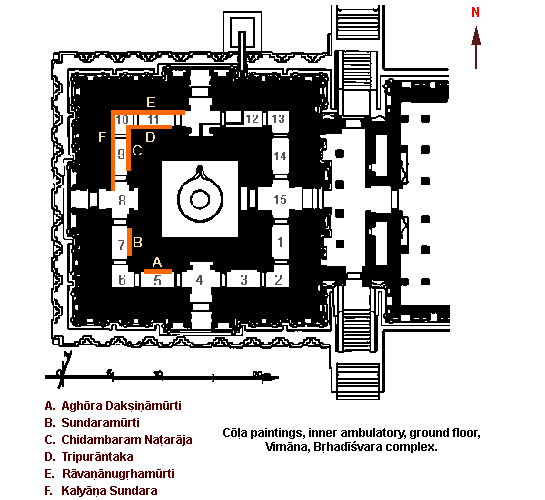
The main sanctum of the Bṛhadīśvara temple complex is so constructed that it is surrounded by two walls: an outer and an inner wall, separated by a 1.88 meters wide inner ambulatory passageway. On either walls of the dark and narrow passageway are found exquisite paintings. These paintings were discovered in the 1930’s and were dated as belonging to the Nāyaka period. A closer inspection, however, revealed that the walls of the passageway consisted of not one but two layers of paintings belonging to two different historical periods. The original 11th century Cōḷa paintings were superimposed by the later 17th century Nāyaka paintings; the second layer had been performed without removing the original layer.
Today, the Cōḷa paintings can be seen on the eastern wall of bay 7, northern wall of bay 5 and on either wall of the bays 9, 10 and 11. The paintings are in the form of panels, depicting various scenes of which some are still discernible- Panel depicting Siva as Dakṣiṇāmūrti set in a forest scene, the events in the life of Sundaramūrti Nāyanār, the worship of Śiva as Lord Naṭarāja by Rājarāja Cōḷa and his queens, Panel depicting Śiva as Tripurāntaka and a portrait of Rājarāja Cōḷa with sage Karuvūr Dēvar. The Cōḷa paintings are in Fresco technique where the pigments are integrated into the lime plaster applied to the walls.
The paintings in the passageway of the Bṛhadīśvara temple are the only remaining examples of Cōḷa paintings that we have today. It is apparent from the lines, bodily postures and the expressions on the face in the Cōḷa paintings that the artists were equally skilled in handling both human forms and nature.