Natural Powers |
 |
Man’s perception of the phenomenal world – comprised, by one way of reckoning, of the vegetal, the animal, the terrestrial, and the celestial – has led to the creation of a vast variety of masks. Some are more imitative or representational, while others assume a far more abstract or symbolic shape.
Around the world, origin myths speak of the elements – often variations on earth, water, fire, air, and ether – that create the cosmos out of the boundless void, or, sometimes the primal ooze. Since ancient peoples lived in closer proximity to and, perhaps, in greater harmony with the elemental powers of nature, they created masks that bore a direct relation to the natural world. The Nepcetaq mask from southwestern Alaska represents variously the universe, water, air, and land; the holes in the mask’s surface represent the ‘sky-holes’ or passages through which animals move in their journey, or, it is also said, cosmic bodies such as the moon and the stars. A great number of Kwakiutl masks from northwest America are also related to the elements of creation. While certain raven-shaped ones take the imagined form of a being that can capture the powers of the sun, others control the energies of fire and water. |
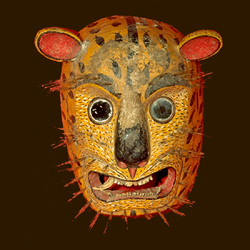
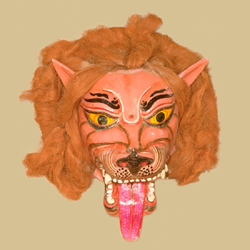
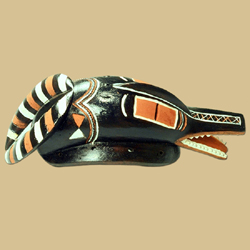
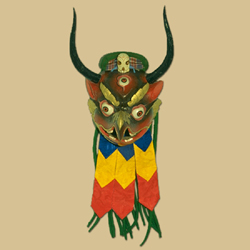
The use of masks of animals to manifest the presence of animal spirits and the power of natural forces is wide spread. Prehistoric cave and rock paintings depicting dancers wearing animal masks suggest that the animal mask was a potent means to bring bison and other game under control. Animal predators, such as the tiger and jaguar, along with other primates, horned animals (that may or may not be considered sources of food) and prey that have long provided food and sustenance for both human and non-human hunters have all served as inspiration for animal-faced masks. The strongest predators, such as the tiger, and lion, and the jaguar have also been assigned the roles of protectors and guardian deities of the world’s space (the four quarters, the nadir and the zenith), converting awe and fear of the powerful natural forces into alliances with these potential rivals. Animal masks from Tibet and the Himalayan range, from Ladakh, Bhutan, Darjeeling, and Sikkim are often portrayed as dharma-guarding deities who ward off the anti-divine forces and make a passage for the benign powers. |
 |
 |
 |
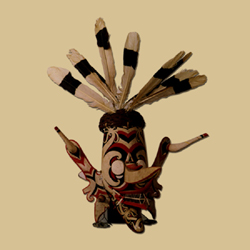 |
Agro-based communities often use masks to invoke and preserve the fecund power of the land and soil. In east Kalimatan, Indonesia, the end of the rice-planting season heralds a succession of ceremonies. Helpful (and ribald) deities don the form of animals to help ensure a bountiful harvest and siphon off the influences that would impede a harvest. After each house and rice paddy is visited, the masked dancers proceed to the river in order to immerse the evil spirits collected and to invoke a blessing for the prosperity of the crop.
Masks acknowledging, celebrating, and (if possible) harnessing the spiritual energy of natural powers and of mankind’s co-inhabitants on earth are deployed in efforts to strike a harmonious balance between social needs and an array of natural forces which may be either benign or destructive towards human survival. |
