Ritual |
 |
 |
In many cultures masks are used as instruments of revelation to connect the seen with the unseen, as mirrors to what is believed to be a cosmic dimension of life. They give a concrete from to the formless and reach out to a realm beyond the immediate.
Masks have different uses in the ritual context. There are masks that are themselves the objects of worship, serving as sacred objects or cult idols, or, perhaps more often, as aids towards focusing the mind on a cherished god or goddess. Deities are frequently represented synechdotally – a part standing in for the whole – and this is generally accomplished through the depiction of the deity’s head or face. In Greece, Dionysus was often represented by a bearded mask attached to a pole. In Orissa, India, masks are frequently used for the temple worship of Shakti, and a set of masks known as Hara-Hari are honored as tokens of the historical fusion of Saivite and Vaishnavite traditions in the area. In Himachal Pradesh, metal plaques representing god Shiva and goddess Parvati are mounted on wooden stakes. These images then stand in for the god and goddess and are honored in a special festival. In Manipur, images representing the idols of Lainingthou and Leirambi, male and female deities, are similarly worshipped during the annual Lai Haroba festival. |
|
 |
 |
||
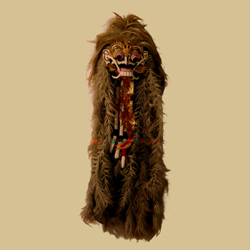
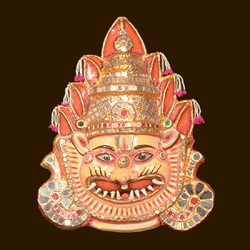
On other occasions, sacred masks are stored in temples and then become conduits used to attract and harness spiritual energy in performance, providing pathway into the body of the wearer. Such is the casewith masks of the Vishnu’s man-lion avatar Narasimha found in Tamil Nadu, Andhra Pradesh, and Orissa on the eastern coast of India. Elaborate costumes made up of grasses, leaves, basketry, bark, and feathers are used by many South American tribes to evoke spirits and mythological beings. Such masks are worn, for example, by the Baroro, the Sherente, and the Caraja Indians of central and eastern Brazil. They function mimetically and symbolically to represent and make manifest images of dreams and visions.
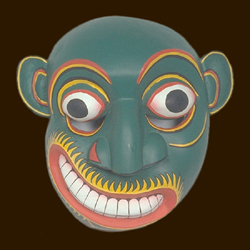
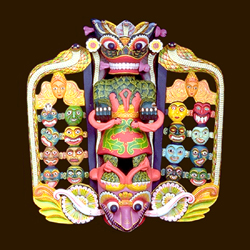
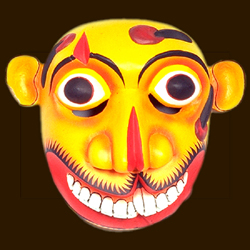
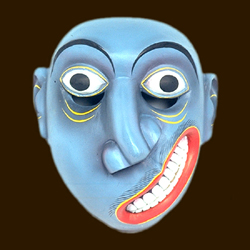
Masks are widely used in initiation rites, life cycle ceremonies,and in rites of sacrifice, exorcism, and ritual healing. In the Sanni Yakuma ritual of Sri Lanka, sickness-causing demons are tricked into performance space and robbed of their deathly sting through laughter; in the Iroquis ‘False Face’ ceremonies, an array of guardian deities with twisted wooden faces and their assistants in corn-husk masks dispel illness amidst din and clamour.
In all of these instances, and in many more of the examples given throughout this section of the DVD, masks are used to increase the efficacy of a ritual event – it’s social utility–while at the same time offering up ways to engage the spectator’s imagination and involvement. This, of course, does not preclude entertainment and enjoyment. Frequently, the mask provides a vehicle for combining aesthetic pleasure with ritual efficacy. |
 |
 |
|
 |
 |
||
