


A Glimpse of Karnataka
Content
- about Configuration CD-Rom
- about History
- Paintings Religion
CONFIGURATION
The present State of KarnĄķaka is situated between longitudes 74 degrees and 12 minutes East; 78 degrees and 30 minutes East and latitudes 11 degrees and 30 minutes North and 18 degrees and 45 minutes North. Its area is 1,91,791 sq. KMS.
Its population is 4,48,06,408, according to the Census of 1991.
Different forms and spellings of the name:
Karnataka
KarnĄķaka
KarļĄķaka
Physically KarnĄķaka is divided in five main regions:
a) The Kanara Coastal Belt, a strip of very fertile land, 30 kms wide at the most, along the West coast.
b) The Sahyadri or Western Ghat, a picturesque chain of hills, culminating at 1925 m. with the Baba Budan peak, often covered with monsoonal type of forest.
c) The Eastern Ranges, a transitional belt between the hills and the plateau; which combines the advantages of the rainy western hills and the drier eastern plains.
d) The Southern Plateau, bordered on the south by the hilly transitional belt between the plateau and the plains of TamilnĄdu, dominated by red soils and an agriculture based on rice, ragi and coconut.
e) The Northern Plateau, north to a line from Chikmagalur to Chitradurga, characterised by large tracts of rich black soils and the cultivation of jowar, wheat, cotton and oil seeds.
The same chain of hills makes the climatic division of KarnĄķaka: to the west the hot monsoonal regime with some 5ms of rain per year; to the east the more temperate climate with a gradually declining quantum of rainfall, from the 2 ms of the Eastern Ranges to the 50 cms of the dry northern plateau.
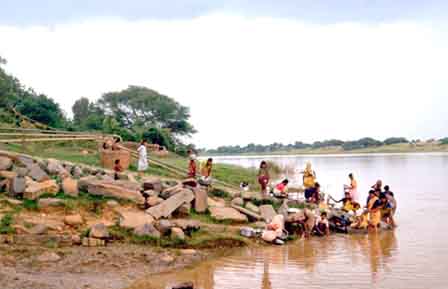
TuīgabhadrĄ River at Haralahalli near Cau·adĄnapura.
The Sahyadri chain is a north-south water-divide between the numerous westward rivers going to the Arabian Sea and the large eastward rivers.
Westward rivers: Mandavi, Kalinadi, Gangavali (or Bedti), Sharavati (with Gersoppa Falls), Haladi, Svarna, Netravati.
Eastward: Krishna and tributaries: Don and Bhima on its northern bank, Ghataprabha, Malaprabha,Tungabhadra on the southern. Tungabhadra is itself the result of the junction of Tunga and Bhadra and has important tributaries: Kumudvati and Varada on its northern bank, Hagari on the southern.
The geological map of KarnĄķaka displays remarkable parallel belts of the Dharwar system which characterizes the south Deccan. The most prominent are the Dharwar-Shimoga, the Gadag-Chitradurga and the Kolar schist belt. They provide a schist of fine texture which has been the choice stone of medieval architects. The same Dharwar system includes also a wealth of ore deposits, such as the iron and manganese of Sandur, the gold of Kolar etc. A long belt of granite from Bellary to the south has provided a good material of construction in the southern part of the state.
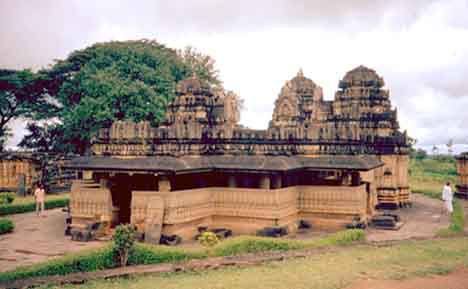
TuīgabhadrĄ River at Haralahalli near Cau·adĄnapura.
Sogayisi baÆda mĄmarane
ta―televa――iye pĢta jĄji saÆ
pageye kukilva k°gileye pĄ·uva
tuÆbiye nallaro―mogaÆ
nagemogado― pa―aÆcaleya
kĢ·uva nallare n°―po·Ąva be
ķķuga―o―amĄva naÆdana
vanaÆga―o―aÆ banavĄsi dŪŋado―
CĄgada bh°gadakkarada gŪyada
goķķiyalaÆpiniÆpuga
―gĄramĄda mĄnisare
mĄnisarantarĄgi puķķalŪ
nĄgiyumŪn° tĒrdupude tĒrido·aÆ
maRiduÆbiyĄgi mŪļ
k°gileyĄgi puķķuvudu
nandanado― banavĄsi dŪŋado―
TeÆkaļagĄ―i s°Ækido·aÆo―nu·i
gŪ―do·aÆiÆpanĄ―da gŪ
yaÆ kivivokko·am birida
malligegaļ·o·amĄda keÆ dalam
paÆge·egoļ·o·am madhumah°tsava
mĄdo·amŪnaneÆ benĄ
raīkusaviķķo·aÆ nenevudenna
manam banavĄsidŪŋamam
“In BanavĄsidŪŋa beautiful mango groves pleasing to the eyes, young betel leaves, jĄti jasmins, campaka flowers, singing cuckoos, buzzing bumble-bees, lovers meeting their beloved with smiling faces are to be seen everywhere in hillocks and pleasure gardens.
O, they are men, those who are abodes of renouncement; enjoyments, affections, chants, discourses; if born, one should be born like those men there, if not, like a cuckoo or even a small buzzing bee in BanavĄsidŪŋa.
When the southern breeze passes gently by my side, when the sweet sounding speeches fall on my ears, when fully blossomed jasmins are at sight, when spring festivities are celebrated, even if there is a goad point on my neck, I will not cease to think of BanavĄsidŪŋa.”
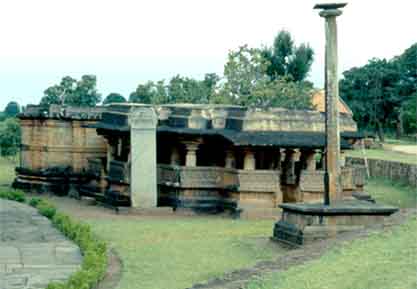
Temple of NagarŪŋvara at Balligave.
Sogayisi baÆda mĄmarane
ta―televa――iye pĢta jĄji saÆ
pageye kukilva k°gileye pĄ·uva
tuÆbiye nallaro―mogaÆ
nagemogado― pa―aÆcaleya
kĢ·uva nallare n°―po·Ąva be
ķķuga―o―amĄva naÆdana
vanaÆga―o―aÆ banavĄsi dŪŋado―
CĄgada bh°gadakkarada gŪyada
goķķiyalaÆpiniÆpuga
―gĄramĄda mĄnisare
mĄnisarantarĄgi puķķalŪ
nĄgiyumŪn° tĒrdupude tĒrido·aÆ
maRiduÆbiyĄgi mŪļ
k°gileyĄgi puķķuvudu
nandanado― banavĄsi dŪŋado―
TeÆkaļagĄ―i s°Ækido·aÆo―nu·i
gŪ―do·aÆiÆpanĄ―da gŪ
yaÆ kivivokko·am birida
malligegaļ·o·amĄda keÆ dalam
paÆge·egoļ·o·am madhumah°tsava
mĄdo·amŪnaneÆ benĄ
raīkusaviķķo·aÆ nenevudenna
manam banavĄsidŪŋamam
“In BanavĄsidŪŋa beautiful mango groves pleasing to the eyes, young betel leaves, jĄti jasmins, campaka flowers, singing cuckoos, buzzing bumble-bees, lovers meeting their beloved with smiling faces are to be seen everywhere in hillocks and pleasure gardens.
O, they are men, those who are abodes of renouncement; enjoyments, affections, chants, discourses; if born, one should be born like those men there, if not, like a cuckoo or even a small buzzing bee in BanavĄsidŪŋa.
When the southern breeze passes gently by my side, when the sweet sounding speeches fall on my ears, when fully blossomed jasmins are at sight, when spring festivities are celebrated, even if there is a goad point on my neck, I will not cease to think of BanavĄsidŪŋa.”
Temple of NagarŪŋvara at Balligave.
Banadase* nĄ·o―elli na·en°rppa·am
alliye ramyavarppa nan l
danavanamalli rĄjisuva hegge
Reyalliye ŋ°bhevetta kab
bina posad°Æķamalliye virĄjipa
pĢgo―avalli k°ki―a
svanada vi―Ąsavalli be―igeyu―a
dhĄnyam samriddha saÆ-ku―am ll
‘In BanavĄsinĄ·u wherever one walks or looks, there are delightful gardens, shining big water tanks, new sugarcane orchards, tanks with flowers (lilies), there resounds the sweet singing of cuckoos, all harvests of grains and vegetables are rich there.”
ll kaÆ ll Ë nĄ·a kaÆpaļaÆ
vasaudhĄnĄrĒtilakadante raÆjisi!
sukhasantĄnado―esevudu siriyi
tĄnagga―avĄgiresedu nĢRuÆbĄ·am ll
“NĢRuÆbĄ·a was a kaÆpaļa in that nĄ·u (BanavĄsinĄ·u) which was like a tilak shining on the forehead of the lady earth, resplendent with children and wealth in plenty.” (Rattihalli inscription no. 1)
From the Rattihalli inscription no. 2. (lines 11 to 14)
“A multitude of bees sucking the sap revolved around newly blown lotuses in beautiful tanks, groups of silvan ladies, wives of silvans tuned their sweet voices to the humming of intoxicated bees, and the charm of their body was equal to that of TamĄla groves, in that BanavĄsideŋa.”
“Besides, mango groves with their young sprouts, bouquets of flowers, heaps of fruits, give excessive joy to multitudes of cuckoos, throngs of bees, hosts of parrots causing great joy to the heart; the juice emerging out of ripe fruits, running in streams, satisfies the desire of rice fields in that viĀaya.”
“Thus, with stately grace, the goddess LakĀmĒ of BanavĄsi was shining with the elegance of NĢRumbĄ·a, her crest jewel.”
Coconut trees surround fully the mango groves with their waters, mango trees surround banana groves with their sweet juices, banana trees surround fully grown sugar-cane fields looking like rows of fruit carriages, fully grown sugarcanes irrigate rice-fields with their well ripe juice, who knows to describe the plentifulness of Guttavo―al?”