


EVENTS
India in the works of Muslim Writers
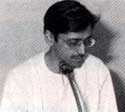
National-in-Katha Reading Contemporary Urdu writer
Dr. Sudhir Kumar in an interesting lecture (May 31) on National-in-Katha Reading Contemporary Urdu writers discussed how some contemporary Muslim Writers such as mushir-ul-Hasan, Abdul Bismillah, Manzoor Ehtesham, Shani, Rahi Masoom Raza (all Hindi writers), Intezar Hussian (Urdu, India born Pakistani writer), Quarraitulain Haider (Urdu), Basheer (Malayalam), Taslima Nasreen (Bengali) and Salman Rushdie (Indian-born British Writer) narrate the nation, called Bharat (India) in their often provoking and provocative "kathas" (narratives). He said their narratives offer multiple visions and versions of a shared and sharable multiculturalist space called Bharat. Their stances vary; their textual politics is often grounded in the problematic of representing the ‘here-and-now’ of a community (i.e. the Muslims) that demands its share in the Project India or Bharat-Nirman through its socio-economic empowerment.
Dr. Sudhir Kumar, Reader-in English, Dept. of Evening Studies, Punjab University, Chandigarh, is a Ph.D. in ‘Politics of Postmodernist Fiction: Rushdie Revaluated’ and ‘Towards An Ecofeminist Praxis: Women & Nature in Atwood’s Novels’. He has a teaching experience of 17 years.
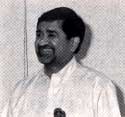
An For Communication Studies in India
Prof. Ramesh N. Rao, Associate Professor of Communication (Personal and Intercultural Communication), Truman State University, Missouri, USA feels that there is inadequate study in the field of Mass Communication in India. It almost always means journalism or mass communication related inquiry or information.
In his lecture (June 14) on Beyond Mass Communication: An Agenda for Communication Studies in India, he said there are two possible areas of research study and application that can be taken up in India. They are: (i) Inter-personal and Intercultural Communication and (ii) Public Speaking and Rhetoric.
The study of interpersonal communication in India will help student learn to pay attention to their communication behaviour in interpersonal settings. The study of Indian rhetoric will provide students lessons in history, language, and philosophy. For too long, these subject have been parceled out among departments that have not interacted closely or effectively, and thus what students have learned about these have come piecemeal. Teaching Indian rhetoric within a communications studies department will provide a fresh boost to some of India’s greatest contributions to humankind. Prof. Rao said.
Tala Vadya Kutcheri By Shri P. Jaya Bhaskar
Mridangam is the most ancient percussion instrument in India. It is considered a divine instrurment as according to the puranas, Lord Vishnu played Mridangam, during the Celestial dance, Tandava by Lord Shiva, while Goddess Saraswati played the veena, Indira the flute and Goddess Lakshmi was the vocalist.
There is also an interesting anecdote about the birth of tabla from mridangam. It is said that once mridangam accidentally broke into two, and when someone tried to play the broken parts, they still produced the nada. The bystanders are supposed to have cried in amazement "Thab Bhi Bhola", which eventually phonetically evolved into the world "Tabla". In Talavadya kacheri, mridangam is accompanied by the Ghatam, Khanjira and Morsing. Ghatam is a pot made of special clay and baked to make it musical. Khanjira is a stretched memberane over a circular ring and Morsing is an instrument made of metal having a pinhead and it produces a melodious nadam. It is also known as Jewish Harp in western music.
Jaya Bhaskar with his excellence in mridangam presented a lec-dem (June 20) on Thala Vadya Kacheeri, bringing out the symphonic effect of different percussion instruments. It is a difficult exercise to bring together several percussion instruments and formulate a full-fledged concert.
What is more, it is a concert using exclusively percussion instruments. Jaya Bhaskar gave his first performance when he was nine. He has accompanied nearly all the contemporary eminent artistes and conducted Tala Vadya Kacheri at several places.
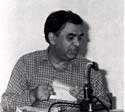
Kashmir Shaivism postulates 36 categories or "tattvas" to explain the process of cosmic evolution. This "evolution and Involution" are part of the manifested material world called ‘Maya’. In a lecture (June 18) on Maya and Aesthetic in Kashmir Shaivism, Shri Virendra Qazi elaborated on the tattvas. He led the audience through the path of understanding ‘Maya’ as per Kashmiri Shaivism. He said we first have to seek the nature of Ultimate Reality called Paramshiva who manifests the total Bliss and who is complete Himself. From him emanates everything. He is beyond description, beyond all manifestations, beyond limitations of Form, Time and Space. He is Eternal, Infinite, all-pervading, all-knowing and all-powerful. In fact, this reality is ineffable and beyond all descriptions.
Shri Qazi with his deep exposure to Indian tantra and mysticism is interested in propagating Kashmir Shaivism and Buddhism, especially teachings of Lalleshwari, the fourteenth century pet-saint of Kashmir. In 1992 he compiled the sayings of Paramyogini Lalleshwari and recorded it in audio cassettes, which became very popular. He has been regularly giving lectures on Kashmir Shaivism. Shri Qazi presently the General Manager (Business Development) in National Buildings Construction Corporation Ltd. New Delhi.
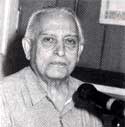
Sanyal And the Art of his time
Babadesh Chandra Sanyal entered his 100th year recently. On that occasion, Prof. P.N. Mago, renowned aretist, art eductationist and art critic, first a student and then close associate of Shri Sanyal delivered a lecture (May 15) on Sanyal and the Art of His Time.
He said, Sanyal can aptly be described as the artist of 20th century India. Born in the beginning of the century, he has lived through it and fortunately for us, even at the age of 100, not only does he continue to be creative in his thinking and his work but is also actively in touch with the present-day art scene. The art scene in the 40’s and 50’s was rather depressive with most artists falling prey to the malaise of confounded creativity. In fact this malaise was common to all spheres of activity. It had been so since early 18th century. The advice by scholars like EB Havell, Henrich Zimmer, William Rothenstein, Dr. Stella Kramrich and of course, Ananda a Coomaraswamy, to the Indian artists to go into their own consciousness or introduce original and vital impulses in their art activity, was not heeded. In such an atmosphere, Sanyal and some of his associates, who had come in to contact with the new styles of painting and the new art movements in the West, mendeavoured to arouse a new awareness in art value through their work, initially in Lahore and then in Delhi after partition. They formed themselves into progressive group, the "Delhi Silpi Chakra", and with their new ideals and programmes soon attracted some of the local intelligentsia and artists seeking change and progress. Thematically, their paintings had contemporary relevance. They looked at their environment critically yet sympathetically. They attempted to develop a new personal style that could meet the demands of their new themes.
Despite the insularity of the visual culture during the last fifty years, India has given birth to two most influential trends the modernistic and the traditionalistc. The latter, as we know well, was invented by a single artist, Jamini Roy, who longed for the past and in a prophetic way, perhaps alerted us to the chaos that was soon to engulf the Indian art scene, Prof. Mago said. Although the influence of Picasso and Moore has been more dominant, there are also the attention-seeking works of younger artists under the influence of pop and surrealists. The cult of personal expression and the new trend in creating installations, as against the growing search for roots in traditional folk and tribal arts, have also become equally popular.
Sanyal, in various phases of his art and modes of expression, not only created a wide impact though his art and personality, but inspired students and contemporaries in the pursuit of their creative expression. His oeuvre-sculptures and paintings reveal him as a man in love with life.
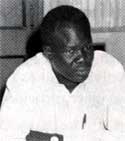
Mr. Chol Deng Yong, Member of the National Centre for Culture and Arts of Sudan visited IGNCA on June 6, 2001. Interacting with the scholars of IGNCA he said his country was rich in ethnic culture. Each ethnic group spoke its own language and had distinct traditions and customs. However, the official language of Sudan is Arabic. He said though the natives were in a majority, the dominating culture is Arab. The major religions are Christianity and Islam. Elaborating on the rich cultural heritage of Sudan, a war-ravaged country, he said there is definite Egyptian influence on Sudan especially in areas close to Egypt.
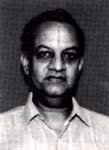
Mr. N Gopalaswami, the new Secretary – Culture
Mr. N. Gopalaswami has taken over as the Secretary Culture, Government of India. Mr. Gopalaswami, an IAS officer of 1966 cadre has served in Gujarat in various capacities for 25 years. He moved into the service of Government of India, as Managing Director of Gujarat Communication and Electronics Limited, a leading public sector company in India in the field of Electronics. He has been Advisor, Education in Planning Commission. Prior to this posting he was Secretary General of National Human Rights Commission.
Mr. N. Gopalswami has keen interest in the field of art and culture heritage of India. He also believes in using information technology in culture, its preservation and propagation.