


Restoring Masks: A Fulfilling Experience
The tradition of making masks is common to almost all the old civilizations world over. Simply defined, a mask is a form of disguise, an object that is frequently worn over or in front of the face to hide the identity of a person and assume the identity of another being. Beyond the superficial, the mask has other functions-social, communicative and religious, Mask is part of the religious ritual in several societies. And hence restoring masks was not a routine technical work. It meant bringing back traditions, rituals and symbols.
Masks are made of a variety of material, depending on the local availability. Some are made for temporary purpose from leaves, meant for short-lived uses (e.g. coconut leave masks of Theyyam, Kerala). The longer lasting ones, used repeatedly during festivals and rituals are made of woods, metals, shells, fibres, ivory, clay, horn, stone, feathers, leathers, furs etc.
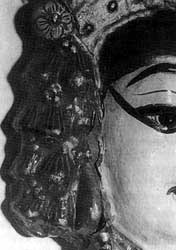
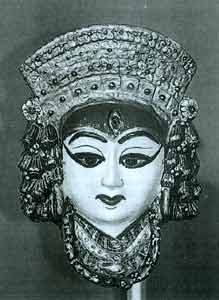
An amazing rare collection of masks from world over find its place in IGNCA. A few masks from Nepal were accidentally damaged and sent to the conservation laboratory. The preservation or disposal of masks is decreed by tradition. Many masks and often their form and function are passed down through clan or families, are usually spiritually reactivated or aesthetically restored by repainting and redecorating without destroying the basic form. Hence it was imperative to study the technique of mask making of Nepal.
Masks of some kind or other are made almost in all the regions of Nepal but masks used for ritual dances and those possessed are made only in the Kathmandu valley and Solu-Khumbu area in the Northern region. Ceremonial masks are made in accordance with traditions, in some cases once every year and in other cases once in twelve years. As most of the mask dances originated in the medieval age (15th to 18th C A.D.) In Nepal, it can be assumed that mask making craft also originated during that period. Nepalese masks are generally made for their use in performing arts but some of them have close relationship with popular folklores, mythologies and superstitions. Masks used in ritual dances have special meanings and significance in forms and designs, which vary from one another.
Clay, cotton, paste or glue, wooden board, wooden mould, water, local paper, jute and colours are essential raw materials for Nepalese masks. For ritual masks clay, locally known as dyaca, which is unlike the ordinary soil, black in colour having profound plasticity and strength, is used. The process of making mask for religious purposes is regulated by rituals, which sanctify the materials. Then the artist spends hours pounding and kneading the first clay. When it becomes plastic or workable, it is ready for forming. Then the individual lumps of clay are placed on wooden boards, pounded with a mallet, and rolled into flat oblong shapes. The thickness varies according to need. This is then gently placed over a low relief mould locally known as thasa of the select deity. Thasa has already been covered with a clean black cloth of fine quality to prevent clay from sticking to the mould.
The mask makers gently press the flattened clay with their fingers so that it conforms to the contours of the mould. As the mould is in low relief, excess clay from the sides is used to build up prominent features of the mask. Aster flattening the clay in the mould properly, the artist builds up these features of the mask like the nose, eyes, lips etc. He smoothens the entire mask with water and cuts the overlapping sides to fit the contour of the mould. Then the clay mask forms are left to dry in the shade on the moulds for about four days. When it becomes dry enough to retain its shape, the commissioned mask is carefully lifted off the mould holding the four corners of the black cloth.
When fully dry, they are painted with a mixture of boiled wheat flour, water and animal glue, which dries to an almost opaque finish. This glue is first applied to the back of the masks and covered with large pieces of jute. The jute backing gives the masks additional strength and prevents them from curving inwards. At certain points at the top and on the sides of the masks, two holes about half an inch apart are made and a strong rope, about one eight of an inch thick is drawn through. This is used to fix the masks on the dancers. To make the interior of the mask smooth, a layer of cotton cloth is glued to the jute.
The same glue is next applied to the front of the mask and strips of cotton cloth, carefully cut to fit the contours of the mask, are glued in place. When the cloth strips dry, low-grade Nepalese paper is glued, to give it an even and smooth finish.
After the glued surfaces have dried, which takes about a day, the mask makers apply a white mixture to the face of the mask. The white pigment acts as a primer, a ground and a base colour; it dries within five minutes. When the final application has dried, the face of the mask is sanded with natural jute fibres. This works like a fine grade of steel wool to give the surface an even smoother finish. Now the masks are ready to be painted. All the pigments are mixed with animal glue, which liquifies when heated and are thinned with water. Colour in the commissioned masks is primarily symbolic. specific manifestations of moods of different deities are colour coded so that the non-initiates can recognize them. Surface treatments range from rugged simplicity to intricate carving and from polished woods and mosaics to gaudy adornments.
The mask-makers produce masks in their houses during the day. The ritual masks are generally made by one special caste known as Chitrakars among the Newars of the valley and Lama priest among theSherpas of the northern region. Knowledge of mask making is communicated from father to son, from master to disciple by formulae or mantras recited in their mother tongue. The IGNCA lab used similar technique for the treatment of the masks. The masks were brought in a condition where the clay had cracked and the cloth had torn. A support from behind was necessary to bring the mask back to the original shape. The team-work was a fulfilling experience.
|
By Ritu Jain |
[ Newsletter | List of Newsletter ]