


A Glimpse of Karnataka
Content
- Configuration CD-Rom
- History
- Religion
Religion
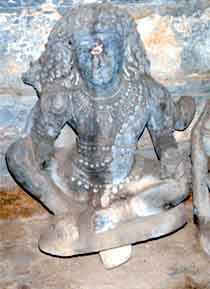
Siva in-the form of lakutĒŋa, at Galagnath.
The history of KĄ―Ąmukhas in KarnĄķaka goes back to the eighth century when the CĄlukyas of BĄdĄmi were the overlords of the region spread between GodĄvari in the north and KĄvŪri in the South. In an article by Dr. G.S. Dikshit there is a reference to an inscription from Paķķadakal dated 755 A.D. which mentions an ËcĄrya named JĩĄnaŋiva who had come to that place from MrigathanikĄhĄraviĀaya on the north bank of the Ganges and who was honoured by the CĄlukya queen Trailokya MahĄdevi. Further the professor writes: “Since JĩĄnaŋiva is a name common to KĄlĄmukhas, he might be one of the first amongst the KĄlĄmukhas, or followers of the LĄkulaŋaiva cult, to come to KarnĄķaka.” The modest beginning of KĄlĄmukha-PĄŋupata movement during the rule of the CĄlukyas of BĄdĄmi continued to be active in the times of the RĄĀķrakĢķas. But, the time was not favourable enough for their activities probably due to the presence of Jains and Buddhists in the kingdom. But in subsequent centuries KĄlĄmukhas, and PĄŋupatas flourished immensely. Their golden days commenced with the advent of KalyĄļa CĄlukyas to power, especially with the accession of VikramĄditya VI to the throne in 1075 A.D.
According to informations recorded in inscriptions, we may safely say that LĄkulaŋĄivas came to KarnĄķaka from the four corners of India, KaŋmĒr, KŪdĄr, Bengal, MaleyĄ―a and RĄmŪŋvaram. Those who came from KĄŋmĒr settled down in the region of BĒjĄpura; those from KŪdĄr made BanavĄsideŋa in modern áimoga district as their headquarters. Once established in KarnĄķaka these áaivites modified the mode of their worship, rituals, customs and manners to fit themselves in the local contexts of the kingdom. In KarnĄķaka they showed their affiliation to árĒŋaila irrespective of their original place. It is yet unknown from when and why árĒŋaila gained importance. May be due to the reason that it is one of the five jyotirliīga centres of India. In its earlier stages árĒŋaila was under the control of KĄpĄlikas. Taking into consideration the facts recorded in an inscription, we can say that, probably, by mid-eleventh century it came under the domination of KĄlĄmukhas, and PĄŋupatas, Since then, the place has not ceased to increase in importance. KĄlĄmukha and PĄŋupata saints and their schools known as maķha appear quite frequently in inscriptions. The subjects that were taught in these schools (maķhas) became part of contents of epigraphs.
Of the two main branches in LĄkulaŋaiva school, KĄlĄmukha and PĄŋupata, the former belonged to áaktipariĀe and the latter to SiÆhapariĀe. Possibly, KĄlĄmukhas, attached more importance to the áakti or the goddess, PĄŋupatas to the lion (siÆha) Her vehicle. Whether it is áaktipariĀe or SiÆhapariĀe they aligned themselves on the school at árĒŋaila which they called ParvatĄvali.
In áaktipariĀe there were many branches notably MĢvarak°ļe at Ba――igĄve, KiķķagĄvesantati at Raķķiha――i and another called Be――esantati.
According to PampĄmĄhĄtmya the derivation of the name KĄlĄmukha is as follows: KalĄmukha means that in which the kalĄs are well-established. That which has relation with only kalĄmukha is accepted as kalĄmukha. Those who practice that, are taught as being kalĄmukha. Nivžtti, pratiĀhĄ, vidyĄ, ŋĄnti, ŋĄntyatĒtĄ. All these are kalĄs in the present [doctrine].
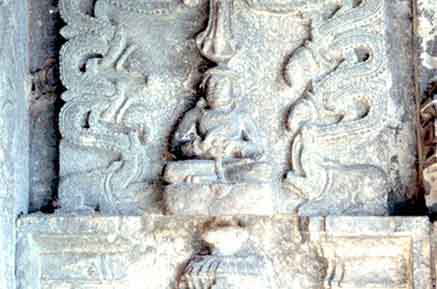
A vĒraŋaiva devotee worshipping the linga in his hand. South wall of the raīgamaļ·apa.
Basava, the founder of the future VĒraŋaiva movement, has been the finance minister of the KalacĢri King Bijjala. The believers of LakulĒŋa áaiva, KĄlĄmukha and PĄŋupata schools had become powerful. Building temples and making grants for temple services was their motto, the primordial means they proposed to attain liberation. But, those who did not have enough wealth to participate in these activities, nor to contribute in any way, were unhappy and worried. Moreover, all revenues of villages and fields were going to the temples. The king’s treasure ceased to increase. In order to save the people and the kingdom, Basava found a very simple way.
He awakened the sense of duty in people’s mind and heart and campaigned with the motto kĄyakave kailĄsa “Work is Worship”. Do your duty and the god will come to you. If the duties are accomplished with devotion that is enough to please the Almighty. To make his thoughts go directly deep in the hearts of common people, Basava used the literary genre of vacana “saying”. In simple words he propagated his ideas. In no time he met with unprecedented success. Many joined hands with him to give an impetus to his principle “work is worship”.
In one of his Vacanas he says :
u――avaru ŋivĄlayava mĄ·uvaru, nĄnŪnu
mĄ·ali ba·avanayyĄ enna kĄlŪ kaÆbha,
dŪhavŪ dŪgula enna ŋirave honnaka―asavayyĄ,
sthĄvarakka―ivuÆķu jaÆgamakka―ivilla
kŪ―Ą kĢ·alasaÆgamadŪvĄ
“Those who are wealthy can construct temples but I am a poor one. My body is the temple, my feet are the pillars and my head is the pinnacle; Lo ! god KĢ·alasaīgama, listen, a Liīga installed in a temple is perishable but not the devotion of a mendicant jaīgama”.)
This kind of diffusing ideas through vacanas became very popular. Every follower of Basava began to compose vacanas and set them to music and sing or recite them. Another principle that Basava adopted was to worship an image of áiva of one’s own choice, that is to choose the name of any image of áiva installed in a temple, be seated at home, take an effigy of a small Liīga, place it in the palm of one’s left hand, offer all the services like bath, sandal paste, flowers, bell, incense etc. and with concentration on that Liīga mentally make áiva present in the form of Liīga one is wishing to pray. This is actually a principle found in Ëgama texts. But, in Ëgamas the worship of áiva in temples is emphasised, whereas Basava proposed to do it at home. According to him going to the temples is not necessary. In case one cannot find time to express one’s devotion to god at home, carrying a small image of Liīga on one’s body is sufficient. As devotees began to wear a Liīga on their body, in subsequent centuries, they were called Liīgins and later LiīgĄyats. Now this is one of the most powerful communities in KarnĄķaka. Some modern historians think that the preachings of Basava curbed temple construction activities. But, this is a baseless attack. In fact, his teachings came as bliss in disguise and became instrumental in the development of temple architecture and embellishment.
Basava also tried to suppress the age old thorn of Hindu society, i.e. the caste system. But this revolutionary idea led to the assassination of King Bijja―a. Basava had to run away from the capital. The whole system ended in chaos. It could only be revived in the fifteenth century when the vacanas were codified and classified under the different categories of the âaķsthala mĄrga “the six-stage way” and brought out under one general title áĢnyasampĄdane. Thus vacana literature became a genre par excellence.
Before the detailed description of áaiva worship, which is its main subject, a standard áaivĄgama, the Ajitatantra, begins with an exposition of the theological concept of áiva as supreme principle called brahman, using a typical upaniĀadic vocabulary:”Only that one who is áiva, superior to all, stable, supreme soul, great lord, whose form is existence, consciousness and felicity, who is free from existent and non-existent manifestations, who is all-pervading, only him is named by the sages with the word brahman. “In the ŋaiva tradition áiva is known as free from beginning, middle and end, free by nature from the stain entity, powerful, omniscient, perfect, non limited by directions of space, times etc., beyond the range of speech and mind, without parts, without action, all-pervading, always all-experiencing.”
After introducing the concept of God, the Ajitatantra introduces the concept of worship. It emphasizes the difference between the worship of a yogin through only mental processes, fixation of the mind on God etc., and the activities of other men of lesser mental capacity. Only the former experiences the supreme áiva. The latter is not qualified to enter into relation with him. The concept of the supreme is the concept adapted to the concept of mental practice of yoga.
“The worship of this áiva can be the inner worship of yogin-s only. Men who take pleasure in the practice of yoga, whose mind is purified by the eight components of yoga, restraints etc., worship him in the middle of the lotus of their heart, no others. The action of worshipping him is superior. Without his worship, with any other [rite] there is no benefit for embodied souls.”
There is another, concurrent, concept of God adapted to the concept of worship in the form of rites comprising not only mental attitudes, but also speech activities and bodily gestures. Both types of worship are not conflicting but complementary. Tantra deals chiefly with ritualistic worship, Yoga chiefly with mental actions and psychological states.
30b-32. The undertaking of the inner worship falls upon someone sometimes; the undertaking of the outer worship falls upon those who have a little knowledge. Being aware of that, this lord of gods, áiva, who stands inside everything, who extends his grace to all and gives to creatures experience and liberation, this áiva became SadĄŋiva whose body is the five brahma[-mantra-s] manifestly.
33-34a. From him arose Ėŋvara, the origin of all the gods, free from decline. From [Ėŋvara] I was born and from me you, the teacher of the universe, arose. From you, in the lotus of your navel, sprung forth Aja, the grandfather of the world.
34b-35. The consciousness who inhabits áiva should be celebrated as MĄyĄ. Others [call her] “Root principle [of matter]”. She also stands in a relation of material cause and effect in five bodies. Hear her establishments.
36-38a. From her [is born] the deity ManonmanĒ resting in SadĄŋiva. From [ManonmanĒ] is born GaurĒ resting in Maheŋvara. From [GaurĒ] is born UmĄ who is mine; she should be BhavapriyĄ. From [UmĄ] is born PadmĄ resting on you, ViĀļu. And from [PadmĄ] is born VĄļĒ resting upon Brahman.
The concept of kalĄ is important in all schools of áaivism and plays a special role in the religion of kĄlĄmukhas. It is closely related to the concepts of áakti and bindu. There are two aspects of áakti. On one side, it is the spiritual essence of God, the power of universal knowledge and action called dĪk-kriyĄ-áakti or cit “consciousness”. On the other side it is the prakĪti or material cause of all that is not cit. In áaiva philosophy the latter has two forms, pure and impure called bindu and mĄyĄ. MĄyĄ is the well-known concept of the matrix of the world, psychic and material, of common experience. It produces all the constituents of human body, senses and mind etc. It provides a matter for the bound soul, which transmigrates in worldly lives.
Bindu is a purer form of mĄyĄ. It provides matter for the higher souls in the hierarchy, who are close to liberation, such as Vidyeŋvara-s delegates of the supreme áiva in his functions of creation etc., Mantra-s instruments of his grace etc. Bindu is divided in five parts kalĄ which form a scale and are from the lowest to the topmost: nivĪtti, pratiĀhĄ, vidyĄ, ŋĄnti, ŋĄntyatĒtĄ. They are related to ŋakti-s or powers of áiva having definite functions. The concept of these functions, as defined by MĪgendrĄgama in the chapter on adhvan in its VidyĄpĄda illustrates well the hierarchy and the names of the kalĄ-s in relation to the attainment of liberation:
“Those powers by which [áiva ] does the opening of the light of [consciousness of] the soul, are the Lords of worlds called nivĪtti, etc.”
Two important points appear here. The worlds which are transformations of mĄyĄ and bindu are grouped under five heads, which are the kalĄ-s, nivĪtti, etc. Each group is ruled by a Lord who is a ŋakti of áiva. These five ŋakti-s have a common character, which is to contribute to the awakening of the powers of knowledge and action of the souls, and thus to contribute to the attainment of their goal.
Their respective functions are as follows:
“The [ŋakti] by which [áiva ] checks the creation of elements and living species, is the checking power; the place where it occurs is called check [point] (nivĪtti), and the Lord [áiva considered] in this place is called possessor of nivĪtti.
The [ŋakti of áiva] by which the fall of the checked soul [in lower births] is suppressed is the pratiĀķhĄ [stabilising power]; its location [is called stabilisation pratiĀķhĄ)] and the Lord over it is possessor of pratiĀķhĄ.
The [ŋakti] by which [áiva] gives the soul a knowledge the contents of which do not come from verbal testimony or inference [i.e. direct experience], is the vidyĄ [power giving direct experience]; its location [is called place of direct experience vidyĄ]) and the Lord over it is Lord of vidyĄ.
The [ŋakti] by which Hara achieves the pacification of all the sufferings of the soul is the ŋĄnti [pacifier]; its location is called place of pacification ŋĄnti) and the lord who accomplishes it is possessor of ŋĄnti.”
This passage of MĪgendrĄgama deals with only the above-mentioned four kalĄs. There is a fifth one called ŋĄntyatĒtĄ beyond ŋĄnti. It is easily identifiable as the supreme áakti of áiva. And the MĪgendrĄgama itself in its KriyĄpĄda qualifies it as bindu – antasaÆŋrayĄ (VII, 82) “having a residence at the top of bindu”.
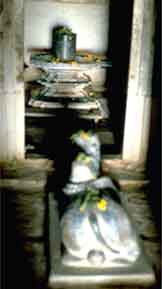
Linga called Sparŋa-linga, temple of Galagesvara at Galagnath.
Liīga is first a philosophical concept defined thus by Ajitatantra:
puruĀasya tu yac cihnaÆ
puruĀavyaktikĄraļam l
sadĄŋivasya talliīgaÆ
áivaliīgam iti smžtam ll
“That which is a sign of the soul, i. e. a cause of manifestation of the soul, such a sign for SadĄŋiva is traditionally known as áivaliīga.”
It is remarkable that the word Liīga is explained here in its common meaning of sign or cause of manifestation. It is something from which one can, not only infer the existence of the soul and SadĄŋiva, but also perceive it directly. It is an object which makes another entity manifest. It is also remarkable that the expression áivaliīga “Liīga of áiva” is explained as referring to SadĄŋiva. The worship of the Liīga is the worship of SadĄŋiva, i. e. the form of áiva manifested under the form of five mantra-s addressed to five faces of the god. Even if the faces are not represented on the Liīga, the worshipper pictures them in his mind and addresses his actions to them.

Linga and Nandin, temple of SomŪŋvara at Haralhalli.
The Liīga is also a mythological concept, well-known in PurĄļas and áaivĄgamas. The account of Ajitatantra is as follows. It involves three hierarchised manifestations of the supreme áiva: SadĄŋiva who is the Liīga, Ėŋvara and Rudra. ViĀļu and Brahman are also manifestations of the Supreme and of still lower rank. The narration is done by Rudra to ViĀļu.
kĢķasthaŋ ca mahĄdevaÅ
sarvakĄraļakĄraļam ll
tvadĄder yo mamĄdis tu
tasyĄpy ĄdiÅ sadĄŋivaÅ l
“2b-3a. SadĄŋiva, the unchangeable, great god, cause of all the causes, is the origin of that entity who is the origin of me, origin of you.”
“3b-5. Both of you, NĄrĄyaļa and Brahman, even though you are omniscient and omnipresent, were unable to perceive me, your mind being afflicted by delusion. Full of delusion and infatuation about the superiority in strength of one upon the other, each one claiming “there is none superior to me”, out of jealousy in each towards the other, both of you, desirous of killing yourselves mutually, furious, were going for your destruction”.
“6-7. Then, seeing such a delusion in both of you, lords of gods, áiva, the origin of all the gods, embodied in ŋabda-brahman, in order to enlighten you, bore the form of a fire-column, creating wonder, and he, the supreme Lord, stood between [you both]”.
“8-10. You, best among gods, went to the greatest astonishment. Wondering: “what is this?”, ready to examine it, with the desire to see its extremities, you went towards the top and the bottom of that form of the Liīga, with the respective bodies of a haÆsa and a boar. Both of you, lords of all the worlds, came back, without fulfilling your purpose. Bowing down and praising the lord of gods, you stood on his sides.”
“11-13. Then, seeing your devotion, áiva, the lord of all the gods, despatched there Ėŋvara, as giver of knowledge to you. And this lord of gods, this peace-maker [said] to you: “you do not know the lord of gods, cause of all, imperishable, SadĄŋiva, the great god, leader of the gods. I, Rudra, and you two, all of us are born from his grace.”
“14-15. This [column] is the sign of him. I, Rudra, and you, let us make a similar [Liīga] with different materials, as we desire, and let us always worship the Lord of gods. Worshipped on the head of the Liīga, the omniscient will always give knowledge, to calm down delusion.”
“16-17a. Seeing our procedure of worship, the fourteen-fold world will worship the Liīga, and it will bestow the highest fruit.” Having spoken thus, Ėŋvara suddenly disappeared with the Liīga.”
The deity is conceived as an abstract entity, which has numerous external manifestations. There are several degrees of manifestation of the supreme. The idea of manifestation is expressed in Sanskrit by the root aĩju “to become manifest” and the preverb vi which indicates the idea of separation. The supreme áiva is a-vyakta “non-manifested”. It differentiates itself in a new entity called vyakta-a-vyakta “manifested and non-manifested”, then in a third one called vyakta “manifested” fully. By “manifested” is understood the quality of being accessible to the senses. Manifestation is achieved by the Supreme God himself through parts (kalĄ) of its power (ŋakti) in its aspect of pure material cause (bindu). Therefore the supreme is also called niĀkala “without [manifesting] part [of power]”. The second entity is sakala-niĀkala, the third sakala. Each entity has a name: the supreme is áiva, the second SadĄŋiva, the third MahŪŋa. áiva is one, the other two have subdivisions: SadĄŋiva five, MahŪŋa twenty-five. This is clearly stated in áaivĄgamas such as VĄtulaŋuddha:
“The essence of áiva is well-kown as niĀkala, o MahĄsŪna. In this [scripture] SadĄŋiva is told to be niĀkala and sakala. One should know MahŪŋa as sakala. Thus there are three aspects. One should know áiva as one. SadĄŋiva should be of five aspects. MahŪŋa, o MahĄsena, has twenty-five divisions.”
The supreme áiva is not the subject of any representation in the temple, because of its unmanifested nature. It is dealt with in rituals only through a mantra, called mĢla-mantra “the root-mantra”.
SadĄŋiva appears in the temple in the form of the liīga, which can be told to be manifested, since it is a visible object, and also non-manifested, since it is a purely geometrical shape, not revealing any particular aspect of the manifest God. The aspect which remains non-manifested in the Liīga is properly called SadĄŋiva or SĄdĄkhya. There are five SĄdĄkhyas or five heads which remain in the imagination of the worshipper. In rituals the visible Liīga is not the real object of worship. It is a support on which the worshipper superimposes the five heads by means of mental representation (dhyĄna). The heads are not manifested. They remain in the mind of the worshipper. They are introduced in the rituals through mantras called brahma-mantras. This concept is very important, for it is the very basis of the religious activity, which integrates mental representations in pure ritualistic actions. It answers perfectly to the religious need of integration of mental and material actions.
“He (áiva) should be sakala and niĀkala for the purpose of meditation and worship; o MahĄsena, this form is well-known as SĄdĄkhya.”
The third áaiva entity, MahŪŋa, is the fully manifested form, with characteristic features and actions, detailed descriptions of which are given in mythological accounts of Ëgamas and PurĄļas. In general the diverse myths about áiva depict him with the attributes of a king, with a benevolent attitude to submissive and loving subjects or with violent actions against enemies. áiva is the Lord of the universe, chastising powerfully the evil forces and giving grace to devotees. He has a palace on a mountain, KailĄsa, and a court of other submissive gods, celestial beings, saints, sages, yogins, etc.
“One should know MahŪŋa as sakala, conducting creation, maintenance and destruction [of the world]. This bodily form should be diverse through twenty-five varieties.”
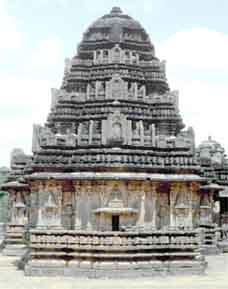
The temple of MuktŪŋvara at Cau·adĄnapura, west facade.
The elaborate theological concept of the supreme god manifesting himself in several grades is well reflected in the architectural concept which comprises a general volume sheltering the Liīga and numerous secondary structures dedicated to the outward manifestations. The former is the garbhagĪha, the secluded cella, innermost centre of the monument. The latter have the form of the main temple in reduced size and are superimposed on its external face.
The monument as a whole, with its tower in pyramidal form can be taken as the representation of the KailĄsa mountain. The interior and central cella sheltering the Liīga is the private residence of the god-king in his palace. The court of that king is provided with architectural spaces, which are the miniature images of temples arranged outside on the walls. The relation of manifested-cum-non-manifested with the fully manifested is transcribed in the architecture by the disposition which gives a secluded and hidden shelter to the Liīga, and outward, fully exposed places to the manifested images.
The reduced representations of temples are frequently treated as decorative architectural motifs by historians of art. But they can also be understood as being something more than a decoration. They have a close connection with the main structure, and must have a theological dedication, as well as the main structure. The dedication of some of them to the external manifestations of the deity is shown through images of several mĢrtis placed on their prominent face or even inside them in the case of niches.